


CEIBS hosts 7th Annual Marketing Symposium, advancing global academic dialogue


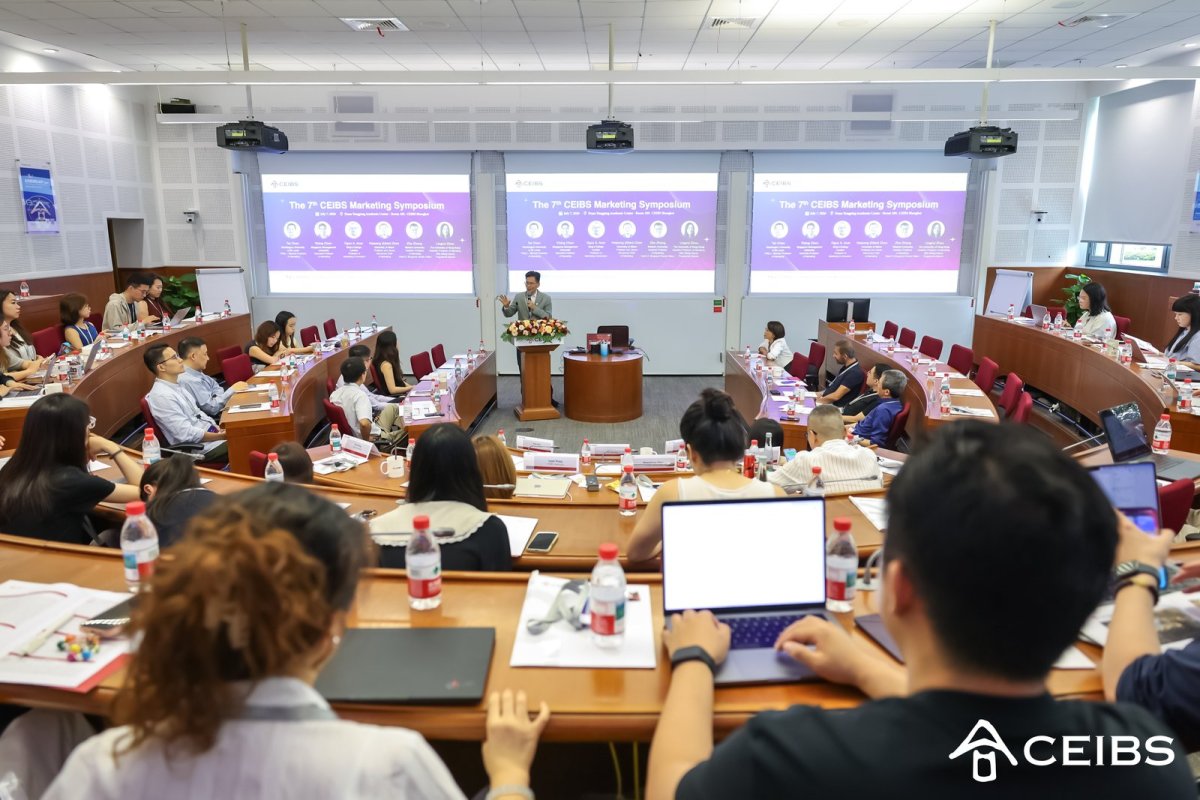
July 7, 2026. Shanghai — The 7th CEIBS Marketing Symposium was held at the Duan Yongping Academic Centre on the CEIBS Shanghai campus today, bringing together nearly 100 renowned scholars from leading global institutions to explore the latest frontiers in marketing research.
The symposium provided a vibrant platform for in-depth academic exchange, featuring presentations on cutting-edge topics including recommender system design, digital healthcare interventions, online persuasion strategies, pricing presentation formats, AI-generated content implications, and brand responses to stigmatised populations. Each presentation was followed by a lively Q&A, facilitating robust discussion between presenters and attendees.
In his welcome address, CEIBS Vice President and Co-Dean Tian Zhu emphasised the importance of such gatherings in advancing both theoretical and practical understanding of marketing. He reiterated CEIBS' commitment to its mission of delivering "China Depth, Global Breadth," highlighting the symposium's role in bridging academic excellence and real-world business application.
The one-day event included six presentations, each of which lasted one hour and incorporated post-presentation discussion. Below are summaries of the papers presented at this year's symposium.
________________________________________
The Impact of Recommender Systems on Content Consumption and Production: Evidence from Field Experiments and Structural Modeling
Presenter: Tat Chan, Washington University in St. Louis
This study investigated how recommender systems on content-sharing platforms such as TikTok and Facebook affect both user consumption and content production. Through a randomised field experiment on a major video-sharing platform, the researchers manipulated algorithm recommendations based on creator popularity. Results showed that recommending less popular creators reduced video-watching time by 1.34% but increased video uploads by 2.71%, revealing a critical trade-off. Counterfactual analyses suggest that optimal strategies often involve promoting less popular content to boost production, challenging current industry practices.
________________________________________
Can Digital Patient Navigation Improve Outpatient Care Experience? Evidence from a Large-Scale Field Experiment
Presenter: Yixing Chen, Singapore Management University
Collaborating with a major public hospital system in China, this study conducted a large-scale field experiment involving approximately 850,000 patients over three months. Results indicated that only 3% of patients adopted the digital navigation tool, with minimal population-level effects on visit duration or satisfaction. However, conditional on adoption, the tool significantly increased visit duration by reshaping patient behaviour—patients entered queues earlier and completed more tasks, ultimately extending total hospital time. The findings suggest that information-based digital technologies may fail to alleviate operational bottlenecks in capacity-constrained healthcare systems.
________________________________________
When the List "Gets" Me: Persona Framing and Persuasion in Online Recommendations
Presenter: Oguz A. Acar, King's College London
Across nine studies, this research examined how describing products in terms of who they are for (rather than what features they offer) enhances persuasion, decision confidence, purchase intentions, and willingness to pay. This effect operates by increasing consumers' perceived sense that the recommender understands their needs. The effects generalise across human and algorithmic sources, product categories, and sponsorship disclosure, but are attenuated when personas mismatch consumers' identities or evoke stigmatised identities. The findings offer new insights into recommendation-list design in AI-mediated decision environments.
________________________________________
The Adverse Effect of Strikethrough Pricing on Purchase Intention
Presenter: Haipeng (Allan) Chen, University of Miami
This research examined a novel factor in discount presentation: the strikethrough format on original prices. Across multiple studies including a field experiment and eye-tracking analysis, the authors found that strikethrough pricing decreases perceived deal attractiveness and purchase intention due to lower processing fluency. Importantly, when the strikethrough line is diagonal rather than horizontal, the negative effect is mitigated. The findings provide actionable guidance for retailers in designing effective price promotions.
________________________________________
Recognition Lost: How AI-Generated Summaries Discourage Review Writing
Presenter: Zhe Zhang, Western University
While AI-generated summaries (AIGS) help readers navigate large volumes of reviews, this research documented an overlooked negative effect on review writers. Drawing on Social Recognition Theory, the authors demonstrate that in the presence of AIGS, writers anticipate reduced recognition for their contributions, leading to decreased likelihood of leaving reviews and reduced writing effort. These effects are attenuated when external incentives are offered. The research offers timely insights into the unintended consequences of AI summarisation for user-generated content ecosystems.
________________________________________
The Cost of Compassion: How Brand Support for Stigmatised Populations Undermines Perceived Product Quality
Presenter: Lingrui Zhou, The University of Hong Kong
Across seven studies, this research revealed that when brands publicly support stigmatised groups, consumers expect lower product quality—an effect driven by implicit lay beliefs that stigma transfers to the supporting brand through courtesy stigma. Quality penalties are most pronounced when the population's condition is perceived as self-inflicted. Critically, quality concerns translate into reduced purchase intent only for high-stakes products where failure carries serious consequences. The findings reveal a paradox at the heart of socially responsible branding: moral credit may come at the cost of perceived competence.
________________________________________
The 7th CEIBS Marketing Symposium concluded with a networking session, allowing participants to continue their discussions and explore future collaborations. The event once again underscored CEIBS' role as a hub for global marketing leadership and its ongoing contributions to this important academic field.