



CEIBS Global EMBA "Building Bridges" Masterclass: Winning in Southeast Asia — A Playbook for Going Global
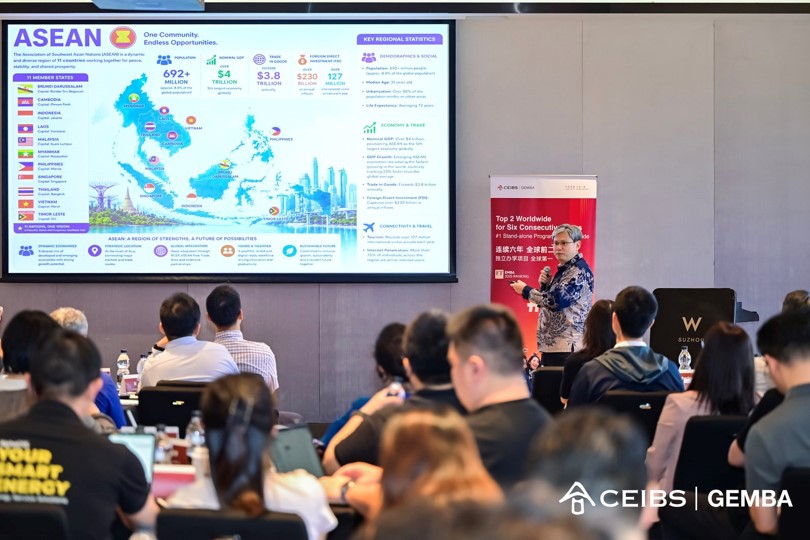
Suzhou, June 12, 2026 — The China Europe International Business School (CEIBS) Global EMBA programme recently hosted a Masterclass in Suzhou as part of its "Building Bridges" (链动未来) event series, themed "Winning in Southeast Asia: A Playbook for Going Global." The event featured lectures by Professor Bala Ramasamy, Professor of Economics, Associate Vice President, and Director of the Global EMBA Programme at CEIBS, and Professor Daniel Chng, Professor of Strategy and Entrepreneurship at CEIBS, followed by a panel discussion with three seasoned executives: Viola Chen, Senior Vice President of Beyondsoft Corporation; Olivia Pan, Brand Director of iFLYTEK; and Eric Liu, B2B Sales Vice President of YADEA Technology Group's Overseas Business Division. Nearly 100 business leaders responsible for overseas expansion attended the event.
Southeast Asia: Not a "Simple Market" but a "Training Ground"
Opening the session, Professor Bala Ramasamy highlighted that ASEAN has become the top destination for Chinese companies' globalization efforts. With a combined nominal GDP exceeding USD 4.2 trillion in 2025, a population of over 680 million, and a rapidly growing middle class, the region presents enormous potential. However, Professor Ramasamy issued a stark warning: approximately 70% of Chinese companies venturing into Southeast Asia fail — a rate significantly higher than the global average of 50%. "ASEAN is not a single market," he cautioned. "It is 11 countries with radically different legal systems, religions, languages, and levels of economic development."
Drawing on data from population demographics, religious distributions, and macroeconomic indicators — ranging from Brunei's GDP per capita of over USD 36,000 to Cambodia's USD 2,550 — Professor Ramasamy illustrated the region's staggering diversity using Hofstede's cultural dimensions framework, revealing significant gaps between China and Southeast Asian nations across power distance, individualism, long-term orientation, and other critical dimensions.
The Geopolitical Tightrope: Trust as the Core Proposition
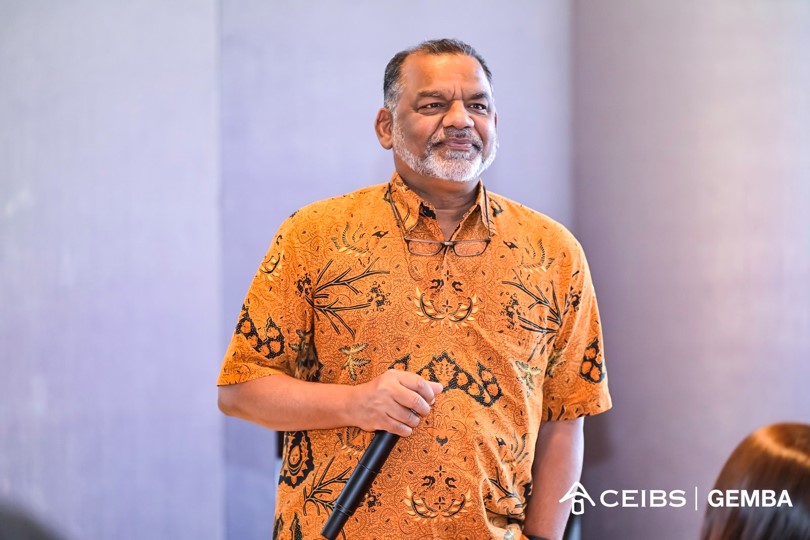
Professor Daniel Chng approached the topic from a strategic perspective, identifying four major categories of challenges facing Chinese firms going global: misreading consumers and culture, falling into competitiveness and market-structure traps, organizational growing pains, and navigating regulation and geopolitical narratives. He emphasized: "Chinese firms' globalization is outpacing their organizational, cultural, regulatory, and geopolitical readiness."
Both professors converged on the central theme of "trust" as the defining challenge for Chinese companies in Southeast Asia. Professor Chng summarized the imperative: "Trust from consumers — built through great brands and service; trust from regulators — built through transparency and compliance; trust from employees — strengthened through local empowerment and talent development. Please don't bring your 996 work culture overseas. Trust from communities — fostered through engagement and a demonstrated commitment to making their country better."
Three Industry Leaders Share Hard-Won Lessons from the Front Lines
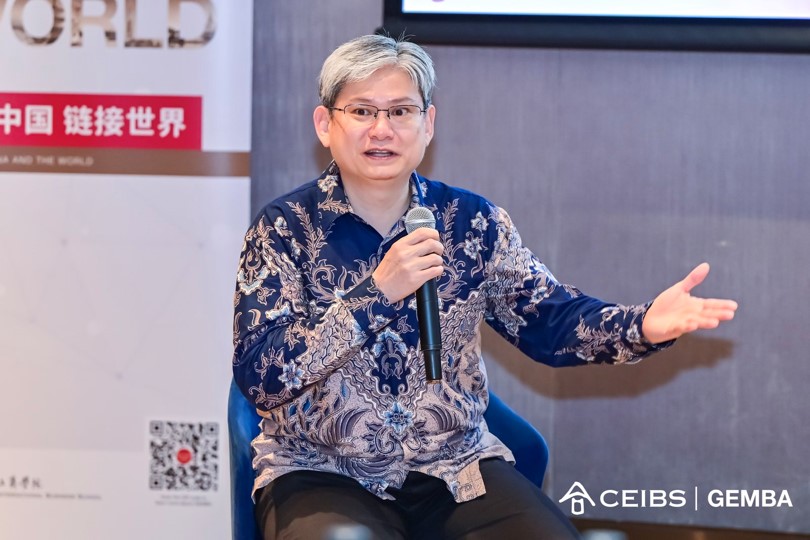
In the panel discussion, the three executives offered first-hand insights from vastly different industries, paid for with hard-earned lessons.
Viola Chen of Beyondsoft reflected on the hard-won lessons from the globalization journeys of the company and its numerous partners. She candidly admitted that many companies, in their early overseas forays, clung stubbornly to a "our-own-people" management model, with overseas executive teams almost entirely Chinese — and as a result, struggled to retain top local talent. "It took us a long time to learn what genuine localization really means," she said. "Today, our localization rate exceeds 80% across every region, and local nationals must be represented at the senior management level." Chen also shared how Beyondsoft earned community trust in Singapore by sponsoring youth basketball tournaments, emphasizing that ESG (environmental, social, and governance) initiatives are a critical pathway to winning trust.

Olivia Pan of iFLYTEK spoke from a brand-building perspective, candidly acknowledging that the company faced near "zero-starting-point" brand recognition overseas. "All the brand equity we built in China needs to be rebuilt from scratch abroad," she explained. She noted that brand communication contexts vary dramatically across markets — Europe focuses on ESG, the Middle East prioritizes return on investment, while Southeast Asia's 11 countries each have distinct needs, demanding a "one country, one strategy" approach to localization. She also cautioned that work-culture differences represent an underappreciated, hidden challenge in overseas brand-building.

Eric Liu of YADEA addressed the supply-chain dilemmas facing Chinese manufacturers expanding into ASEAN. Since beginning its international expansion in 2007 and pivoting strategically to ASEAN in 2019, YADEA has established production bases in Vietnam, Indonesia, and Thailand, with a facility in Mexico positioned to serve the North American market. "Our electric vehicles consist of over 100 components," Liu explained. "If everything is shipped from China, the costs would be astronomical." YADEA has been actively bringing its entire Chinese two-wheeler supply chain overseas, transforming from "Made in China" to "Made in Asia." Liu also issued a cautionary note, drawing parallels to the overnight mass exit of Chinese fuel motorcycle brands from Southeast Asia two decades ago, and emphasizing that balancing quality with sales volume is essential for Chinese brands to build lasting equity in the region — and to avoid repeating history.

ASEAN as a "Training Ground": From Chinese Excellence to Global Competence
Concluding the session, Professor Chng offered a powerful framing: "Many executives believe ASEAN is where Chinese firms go because it is easy. The reality is more nuanced. Chinese companies go to ASEAN because it is difficult enough to teach them the deep lessons of globalization, but not so difficult that mistakes become fatal. ASEAN is therefore not simply a market — it is a training ground. If you can succeed in ASEAN, a Chinese company can transform from a world-class Chinese company into a genuine world-class multinational."
The Masterclass formed part of the CEIBS Global EMBA "Building Bridges" (链动未来) event series. Initiated by the CEIBS Global EMBA programme, this series will cross borders with themed editions covering "China & Southeast Asia," "China & Europe," "China & Africa," "China & the Middle East and North Africa," "China & the United States," and "China & Latin America." Seminars and forums will be held in major cities across China and the world, providing businesses with valuable insights and strategic guidance to navigate an increasingly complex international landscape.
The CEIBS Global EMBA programme has ranked in the top two of the Financial Times Global EMBA ranking for six consecutive years. Guided by the philosophy "Bridge China and the World" (深耕中国,链接世界), the programme is dedicated to developing leaders who possess a deep understanding of the Chinese market, an international perspective, cross-cultural management capabilities, and a strong commitment to social responsibility.