



CEIBS launches AI agent course, spearheading a paradigm shift in management education
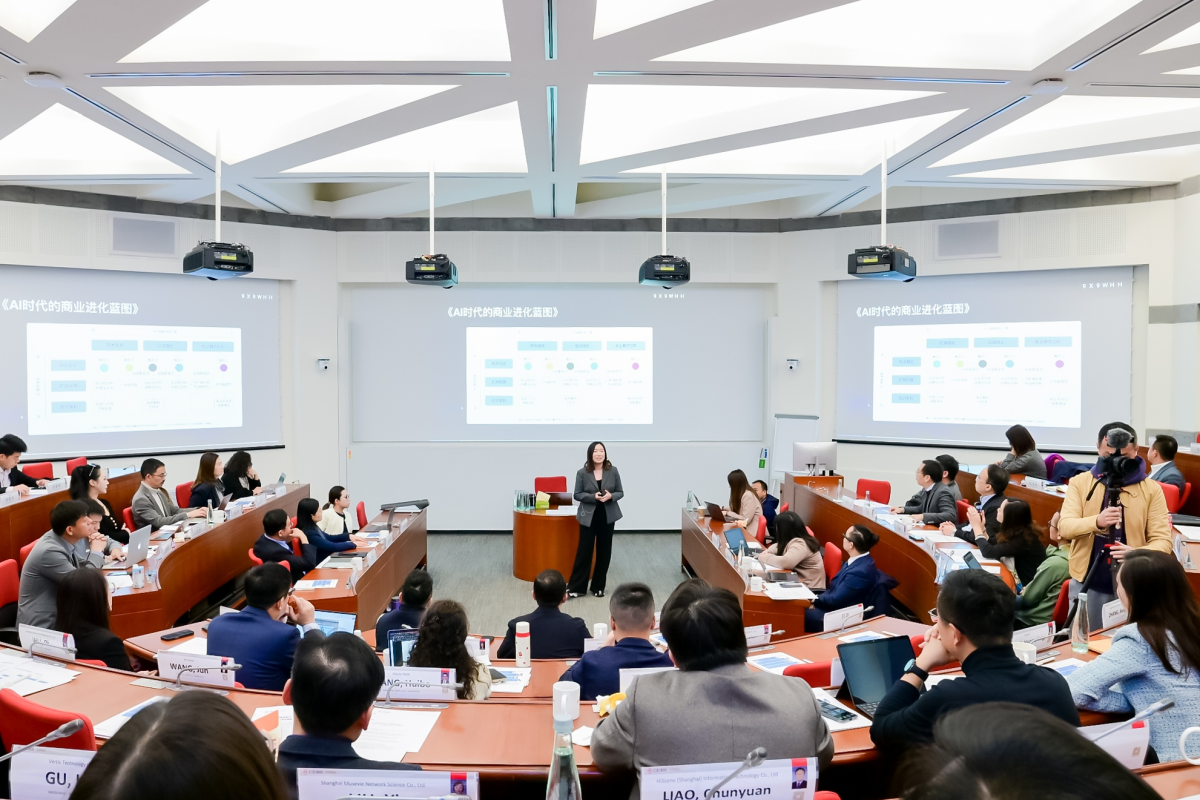



December 12, 2025. Shanghai — Amid the global surge of generative AI, China Europe International Business School (CEIBS) has launched one of the management education world’s first ever AI agent–based courses on “AI‑Powered Enterprise Profit Strategy”. The programme marks the debut of CEIBS’ AI‑enabled business education course series and represents one of the first worldwide to systematically integrate AI agents into the classroom, demonstrating CEIBS’ commitment to staying at the forefront of educational innovation, harnessing AI to empower both the school’s teaching and corporate practice.”
Value Innovation, Bridging Theory and Practice
AI is reshaping enterprise operations and organisational models, demanding new approaches to business education.
In an address at the launch of the course, CEIBS President Wang Hong emphasised that, in the face of accelerating technological waves, business schools must actively explore and innovate pedagogical approaches to cultivate cross disciplinary talent capable of integrating AI theory, technology, products, and real world applications.
“CEIBS has for some time focused on the impact of AI on corporate strategy, organisational design, and management practice. The launch of this ‘AI Powered Enterprise Profit Strategy’ course represents the school’s sustained commitment to fostering connection between AI and business management,” she said.
She further added that CEIBS is spearheading a paradigm shift in management education, moving beyond traditional models centred on classic frameworks and case studies toward a new talent development approach that emphasises algorithmic literacy and human–AI collaboration. By embedding AI deeply into learning scenarios, CEIBS aims to ensure that AI is not just a tool, but a dynamic partner for decision-making, effectively bridging the “last mile” from theory to practical application and highlighting the school’s value innovation in the AI era.
CEIBS Secretary of CPC Committee Ma Lei then noted that the course was independently developed over six months by the school’s R&D team and holds proprietary intellectual property. Unlike typical educational AI applications that mainly improve efficiency, he said, this course introduces a systematic AI application framework that enables learners to transition from experience- and theory-based decisions to data-driven, model-informed “intelligent decision-making.”
“CEIBS plans to expand this initiative into a comprehensive AI course ecosystem, integrating disciplines such as marketing, strategy, management, and finance,” he added. “On the other hand, CEIBS will collaborate with enterprises to co‑develop industry‑specific AI agents, enabling two‑way empowerment between education and practice.”
Looking ahead, CEIBS envisions the creation of a “Business Education App Store,” where participants can deploy AI tool modules flexibly from different disciplines and assemble them into tailored intelligent decision systems suited to their own organisations, transforming learning outcomes directly into solutions for real world business challenges, he concluded.
Empowered Learning — AI as Tool, Partner, and Mentor
Breaking from traditional discussion-based teaching, this course is built around a single teaching case: how a long term loss making hotel can achieve sustainable profitability. Drawing on real world data and industry context from China’s high end hospitality sector, the case is embedded directly into an AI agent system, transforming industry reality into an applied learning environment.
Guided by AI agents, participants can learn by doing, leveraging AI to conduct decision analyses and develop holistic profit strategies beyond single-function perspectives.
Lu Yi, CEIBS Assistant Professor of Marketing and Lead Course Designer for the “AI‑Powered Enterprise Profit Strategy” course, introduced the course’s pioneering “three‑role” AI agent framework. First, as a tool, AI automates data analysis and model computation. She noted that pricing decisions are inherently interdisciplinary, spanning economics, marketing, accounting, and quantitative analysis. AI tools address longstanding pain points in teaching quantitative business courses by encapsulating complex mathematical models into interactive instruments, allowing participants to focus on decision logic rather than calculations. This design helps level the cognitive playing field for learners from diverse professional backgrounds.
Second, as a collaboration partner, the system incorporates virtual personas that simulate consumers and internal stakeholders from different business functions. These personas engage with participants, supporting strategic reasoning and enabling real time validation of decision feasibility.
Finally, as a mentor, AI delivers personalised feedback based on learners’ real time interactions and dialogue during the course. In the future, the system will leverage a growing repository of cases to offer deeper, more advanced decision guidance, further enhancing the role of AI as an intelligent partner in managerial learning and practice.
Empowered Practice — A “Scientific Decision Assistant” for Enterprises
While traditional business education equips managers with strong theoretical and case knowledge, many struggle to apply it effectively in day-to-day decisions. By incorporating AI agents, this course equips students with a portable “scientific decision assistant” that supports data-driven, continuously optimized decision-making in their organizations.
Students have so far responded positively, noting that for small and medium sized enterprises with limited historical data, the system leverages large scale AI models and industry level datasets to rapidly generate multiple pricing scenarios, significantly improving decision efficiency. Meanwhile, through the simulation of end to end decision processes for new product launches, the AI agents allow companies to monitor in real time how marketing and strategy choices translate into profitability, enabling truly profit oriented, dynamic marketing management.
The course has also prompted participants to rethink the internal division of labour between humans and AI. Several have indicated plans to pilot human–AI collaboration mechanisms in selected business functions, gradually building a new decision workflow in which AI focuses on scenario modelling and analysis, while humans remain responsible for final judgment and accountability.
Prof. Lu highlighted that in the AI era, course evaluation is shifting from outcome-oriented metrics to a multidimensional assessment of problem-solving, critical thinking, and innovation skills. The original intention behind the course’s design is to recognise AI’s limits. AI is not a panacea; its true value lies in expanding human decision-making capabilities, not in replacing human judgment. Facilitating human-AI co-learning and optimising collaboration remains an ongoing exploration.
Amid the surging momentum of the AI driven intelligent era, the launch of the “AI Powered Enterprise Profit Strategy” course represents more than a cutting edge teaching experiment. It is a vivid demonstration of how CEIBS is integrating Artificial Intelligence (AI) with Business Intelligence (BI) to cultivate a new form of Managerial Intelligence (MI) suited to the times.
Looking ahead, CEIBS will continue to translate the world’s most advanced management insights into real drivers of sustainable enterprise growth, providing long term intellectual support for companies navigating an increasingly complex competitive landscape.