



CEIBS Executive Forum explores strategic shifts in a fragmented global automotive industry
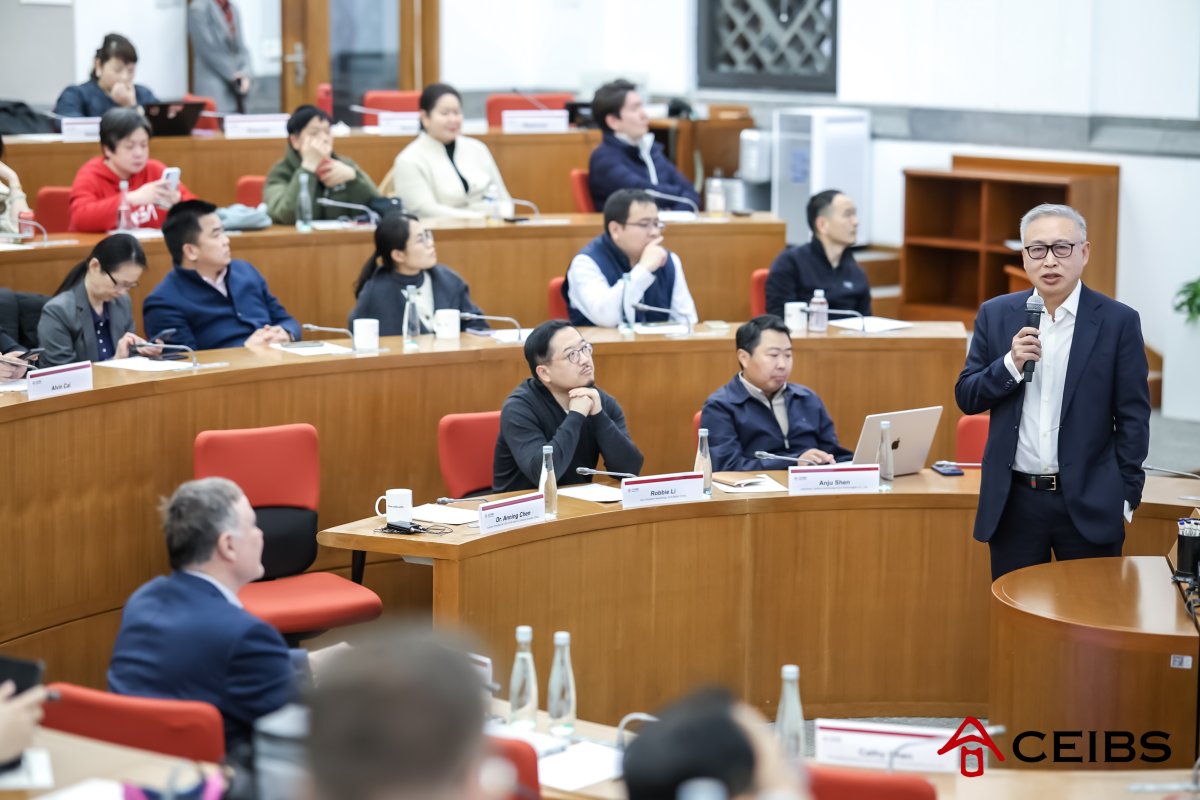






March 18, 2026. Shanghai- Success in today’s automotive industry will increasingly require abandoning outdated playbooks, redesigning organisations from the ground up, and moving beyond “localisation” to “naturalisation” across markets, Former President and CEO of Ford Motor Company Greater China Anning Chen said at a CEIBS Executive Forum on the school’s Shanghai campus today.
Themed Global Automotive Industry: Necessary Strategies for Competing in Fragmented Markets, the event brought together CEIBS students, alumni, and external business leaders to explore what it takes for automakers to compete in an increasingly fragmented global landscape.
Opening the event, CEIBS Co-President (European) Frank Bournois highlighted Dr. Chen’s cross-continental leadership experience and extensive expertise in leading transformation. As a 25-year veteran in the auto industry, Dr. Chen has held senior leadership roles in both Chery Automobile and Ford Motor Company Greater China.
In his keynote, Dr. Chen examined the profound transformation of the automotive industry over the past decade, highlighting growing divergence between major markets. “Between 2016 and 2026, Chinese automakers have increased their domestic market share in China to 65%,” he noted. “In contrast, Chinese brands’ market share in the United States remains close to zero.”
Meanwhile, the gap in electric vehicles continues to widen; while China’s EV penetration has continued to rise year on year, the United States has recently moved in the opposite direction, Dr. Chen said. “The gap in EV penetration between China and the US has reached around 35%,” he explained, suggesting structural differences in policy and market dynamics.
Beyond market share, Dr. Chen observed the emergence of fundamentally different economic models which resulted in different landscape.
The data is unequivocal. Over the last 10 years, car prices rose by roughly 50% in both Europe and the United States, while they declined slightly in China without netting the cost increase of large EV shares. This is not a marginal divergence—it signals fundamentally different economic logics at work,” he explained.
These shifts, Dr. Chen said, were driven by increasingly divergent strategic priorities. As China has accelerated its focus on customer-centric innovation driven by rapid iteration, electrification, digital experiences, and affordable price, Europe and the US, his view, have moved in the opposite direction, prioritising sovereignty, regulatory compliance, and supply chain resilience, often at the expense of customer value.
“You cannot run a 2026 company with a 2016 focus. The strategies that made companies successful a decade ago are not working inside or outside China,” Dr. Chen said, calling on business leaders to cast away legacy assumptions, such as aggressive price competition, “one-size-fits-all” management, and superficial compliance partnerships.
Looking ahead, Dr. Chen outlined the key imperatives for companies to build new strategic foundations. First, companies must redesign their organisations to compete effectively across distinct regulatory and market environments, while developing resilient, region-specific capabilities. Second, he emphasised the need to move beyond localisation and instead “naturalise” their presence in key markets, building deeply embedded and market-specific capabilities to compete in a fragmented global landscape.
The forum also featured an interactive Q&A discussion, where participants engaged with Dr. Chen on practical challenges facing global automakers, cross-border expansion of Chinese companies, and the future of global auto industry.