


Faculty & Research

Faculty & Research
Beyond the AI Race: How AI Is Rewriting Business, Work, and Choice
Artificial intelligence continues to advance at an extraordinary pace. Beyond the race to develop more powerful AI models, companies are now beginning to rethink how businesses operate, how services are delivered and, perhaps most importantly, how value is created.
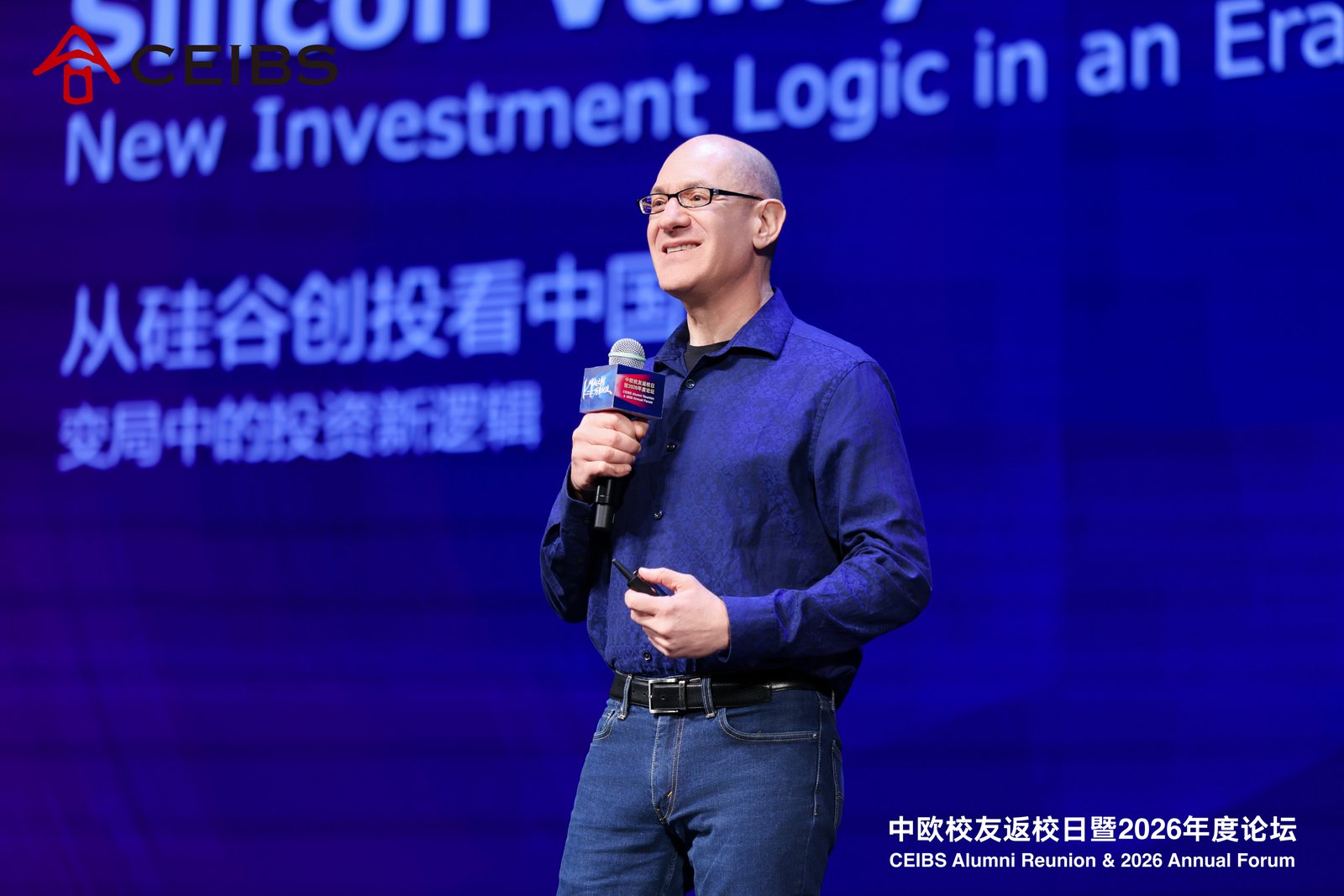
Speaking at the CEIBS 2026 Annual Forum, Steve Hoffman, Chairman of Founderspace and a renowned Silicon Valley entrepreneur and investor, examined the next wave of AI innovation through the lens of venture capital, exploring the opportunities and challenges it presents for businesses in China and beyond, differing development paths in China and the US, and what the continued development of AI could mean for the future of work and human society.
The Global AI Race: The Leading Strategies
When we look at the global AI industry, we see some of the world's largest technology companies competing to shape its future. What's interesting is that they are not all pursuing the same strategy.
Consider what I call the "Fantastic Five": Anthropic, OpenAI, Google, SpaceX and NVIDIA.
Anthropic has been particularly focused on enterprise applications, recognising early on that enterprises, especially those employing software engineers that use AI for coding, represent a major commercial opportunity. Rather than attempting to serve everyone, it has concentrated its resources on becoming a leader in this area.
OpenAI, by contrast, has pursued both consumer and enterprise markets, while Google has invested heavily in multimodal AI, developing capabilities across language, images and video.
SpaceX, meanwhile, illustrates the growing strategic importance of computing infrastructure. Finally, NVIDIA is expanding beyond its dominant position in AI chips into areas such as robotics and the systems needed to power the next generation of intelligent machines.
Then we have the potential dark horses: Amazon, Meta and Microsoft.
Amazon focuses on providing cloud infrastructure to support businesses adopting AI. Meta has pursued consumer-facing applications, with opportunities to extend its AI capabilities to small and medium-sized businesses already using its platforms for marketing and customer engagement. Microsoft is taking yet another approach, leveraging its extensive enterprise customer base. By offering companies greater flexibility in choosing AI models while retaining control over their data, it is positioning itself as a trusted partner for businesses integrating AI into their operations.
All these strategies have potential. The question is which will ultimately prove most successful as the market evolves.
For investors and entrepreneurs, these divergent approaches serve as an important reminder that winning the AI race is not necessarily about developing the most powerful model; it is also about identifying where the greatest commercial opportunities lie and building a sustainable business around them.
The Next Wave: From AI Assistants to AI Agent Swarms
While much of the attention today is focused on large language models, I believe the next wave of AI innovation will be driven by intelligent agents capable of acting independently.
Most of us have already used AI assistants to answer questions, generate content or complete individual tasks. But we are moving towards a future where AI agents will work together across entire organisations.
Imagine a company employing hundreds, or even thousands, of specialised AI agents.
Some might identify software bugs while other agents could fix them, just as additional agents could communicate with customers, coordinate tasks or interact with human employees.
These agents will take on different responsibilities, much like people within an organisation. Rather than functioning as isolated tools, they will collaborate to manage increasingly complex workflows.
This could fundamentally reshape how businesses operate, allowing organisations to automate not just individual tasks, but entire processes.
At the same time, personal AI systems will become increasingly integrated into our daily lives. I don't believe most people will want to manage five or ten different AI assistants. Instead, we are likely to rely on one or two systems that understand our needs and can help us across different aspects of our personal and professional lives.
These systems may eventually operate in different modes, allowing us to keep sensitive personal information private while sharing appropriate information within our workplaces.
As AI agents become more capable, they will create opportunities for new services, applications and ways of organising businesses.
This is also where I see investment opportunities moving beyond the infrastructure that has attracted so much capital in recent years, towards industry-specific applications and AI-first business models.
Beyond SaaS: Why Businesses Will Start Paying for Outcomes
One of the most exciting changes I see occurring is not simply how AI is being used, but how it is transforming business models themselves.
Here is one key example. For decades, software-as-a-service (SaaS) has been one of the dominant business models in the technology industry, particularly in the United States and other Western markets. Companies pay subscription fees to access software platforms, regardless of how much value that software ultimately delivers.
But AI agents are creating opportunities to move beyond this model.
Instead of charging customers for access to software, companies can increasingly charge for the outcomes they deliver.
Consider customer service. Traditional software may provide tools to help employees respond to enquiries, while AI-powered agents can increasingly resolve problems themselves. Instead of relying solely on subscription fees, providers can charge for customer interactions, completed actions or successfully resolved issues.
A similar transformation is emerging in professional services. In the legal sector, AI-first firms are challenging conventional hourly billing by using AI to perform tasks previously undertaken by lawyers, enabling them to offer fixed prices for specific services.
China and the US: Different Markets, Diverging Business Models
Having worked with entrepreneurs in both China and Silicon Valley, I find it particularly interesting to observe how the same technology can lead to very different business models.
Take healthcare as an example. In the US, AI companies are developing agents that can listen to conversations between doctors and patients and automate associated documentation tasks. As AI agents become more sophisticated, this approach could extend beyond recording information to coordinating appointments, completing paperwork and communicating with other hospital staff.
In China, however, some healthcare AI companies are approaching AI from a different perspective. Rather than focusing primarily on the needs of individual hospitals or enterprises, their solutions are also shaped by national healthcare priorities.
This reflects a broader distinction between the two markets.
In the US, AI businesses often focus on improving productivity and generating measurable financial returns for individual enterprises. In China, commercial opportunities may also be closely connected to broader policy objectives and national development priorities.
Neither approach is inherently better. They simply reflect different market environments and customer needs.
For investors, understanding these differences is essential. The opportunity is not determined by technology alone, but by how effectively businesses can apply that technology to the specific needs of their markets.
The Big Picture: The Future of Work, AI Safety and Human Agency
Beyond these emerging business models, I believe we need to consider three fundamental questions about the future of AI: its impact on employment, the safety of increasingly intelligent systems and the preservation of human agency.
As AI agents become more capable, we need to rethink what human work will look like. Today, much of knowledge work involves performing tasks: analysing information, writing reports, developing software, communicating with customers and managing processes. Increasingly, AI agents will be able to perform many of these activities.
In an AI-first company, I believe the role of human employees will gradually shift from executing individual tasks to designing the systems that enable AI agents to carry them out. Rather than doing all the work themselves, people will need to understand how to organise, coordinate and supervise networks of intelligent agents. This could fundamentally change the skills that businesses value and the way organisations operate.
But does it mean AI will eventually replace human workers altogether? The answer is that nobody knows.
Throughout history, economic growth and technological progress have expanded consumption and created new forms of demand. As people become wealthier and new capabilities emerge, they often want more products, services and experiences than previous generations could have imagined.
AI could follow a similar pattern, creating new markets and economic opportunities that require human involvement. The critical uncertainty is whether demand will continue expanding fast enough to create new roles, or whether AI will eventually become capable of satisfying most of that demand with minimal human input.
We simply don't know how this will unfold.
Another major challenge concerns recursive self-improving intelligence, wherein AI systems can contribute to improving their own capabilities.
We are already seeing developments in which AI can identify errors, improve code and help enhance the performance of other AI models. As these capabilities advance, we could enter an era in which AI systems become increasingly capable of improving themselves with less human intervention.
But perhaps an even more fundamental question concerns human agency.
Imagine a future where your AI assistant knows your preferences, understands your circumstances and can make highly informed recommendations about almost every aspect of your life.
You might consult it about your health, finances, career or business decisions. As its capabilities improve, you may increasingly trust its judgement over your own.
This raises a critical challenge: How can we, as a society and as the human race, preserve human agency in a world where AI may become so useful and capable that people trust its judgement more than their own?
As AI transforms industries, business models and the nature of work, we must think carefully not only about what this technology can do, but also about the decisions we want to retain for ourselves.
We are moving towards a future filled with extraordinary possibilities, but also profound uncertainties. How we navigate that future, and how we preserve our ability to make our own choices, are questions we must confront together.