


Faculty & Research

Faculty & Research
Will AI drive the next wave of innovation—or stall it?

The following insights are drawn from a speech delivered by Joel Mokyr, recipient of the 2025 Nobel Prize in Economic Sciences and Robert H. Strotz Professor at Northwestern University, at China Europe International Business School (CEIBS) in Shanghai on March 27, entitled: “The Past and Future of Innovation: Can Progress be Sustained?”
In a global economy that consistently holds up GDP growth as the main indicator of good economic health or otherwise, the “curse of diminishing returns” is a constant concern. For better or worse, economists, investors, politicians and business leaders are all hyper-focused on securing growth, and they all fear the reverse.
However, from Smithian Growth (gains from trade) to Northian Growth (gains from better resource allocation due to institutional change), countless examples show that simply doing “more of the same” – accumulating more resources, securing higher trade volumes, etc. – does not automatically guarantee long-term sustainable growth. The spectre of diminishing returns means that no single activity, business model or political agreement can hope to provide perpetual economic growth and, hence, security.
But does this principle also apply to innovation, and the wider concept of technological progress? At a time when artificial intelligence and a host of other 4IR technologies are poised to reshape the global business landscape forever, are they also susceptible to the same curse?
Low-hanging fruit vs. taller ladders
If the techno-pessimists such as Robert Gordon (author of The Rise and Fall of American Growth) are to be believed, the low-hanging fruits of invention have mostly been picked. Their view is that massive, globally impactive inventions that have shaped whole eras from the Industrial Revolution to the Internet Age now belong to the past.
Increasingly, some believe, future inventions will cost more while ultimately achieving less. The current state of the pharmaceutical industry seems to provide an instructive example; Eroom’s Law demonstrates that, despite the impact of numerous technological advancements, the inflation-adjusted cost of developing a new, FDA-approved drug has roughly doubled every nine years since 1950.
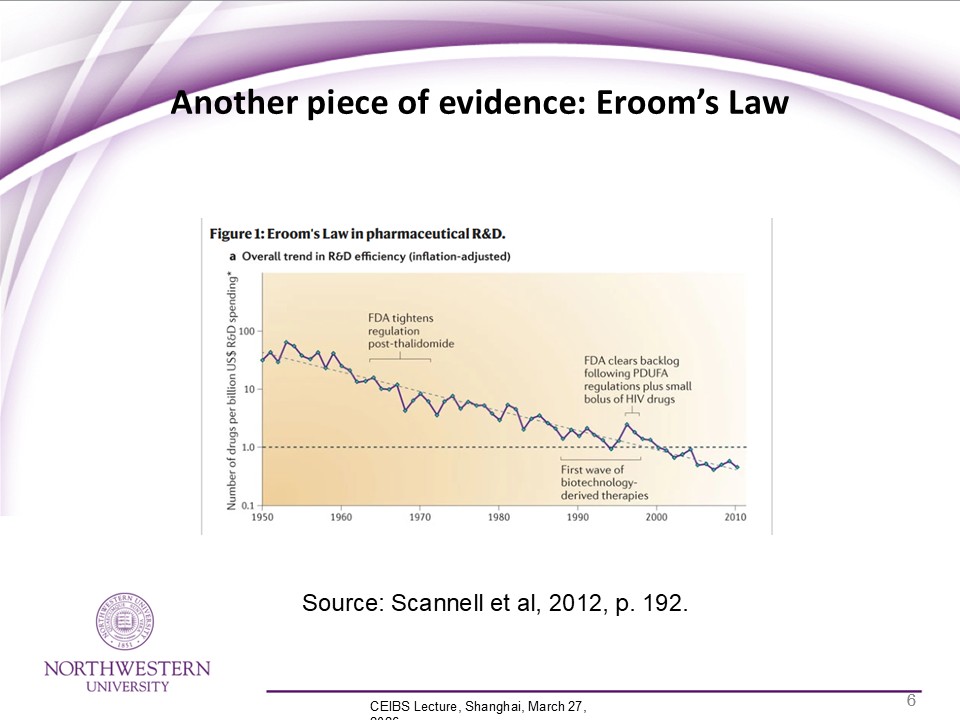
This suggests that technological progress, even iterative breakthroughs in fields such as AI, should not be relied upon as a silver bullet to humanity’s economic difficulties, nor as a vehicle for perpetual growth. The techno-pessimistic view is that its ability to act in this way has already been significantly degraded.
The counterargument goes that even if all the low-hanging fruit has been picked, the metaphorical “tree” of knowledge is still growing, and our collective scientific base of technology will continue to create taller “ladders” to climb it, bringing even more impressive and impactive technologies within easy reach.
AI could create a positive feedback loop of unprecedented scale
Nathan Rosenberg, Professor of Economics at Stanford University in California, has said that science drives technology, but technology feeds back into science. As scientific discoveries prompt the development of new scientific tools and instruments, those tools themselves drive new waves of scientific advances.
This positive feedback loop remains in place today, as vastly improved telescopes, microscopes, superfast computers, lasers, genome-editing tools and a host of other interconnected technologies reinforce their own capabilities while prompting wholly new ideas.
Of those revolutionary ideas, AI remains at the heart of the argument between techno-pessimists and optimists. Will it ultimately make humans smarter, or more narrow-minded and dependent? Will it free us from drudge work, or lock us into new forms of wage slavery to the AI-owning elites?
While the ethical conundrums will undoubtedly take years or even decades to resolve, AI has already demonstrated its ability to strengthen the positive feedback loop of technological progress. As a research assistant, platforms such as ChatGPT and DeepSeek massively outperform humans, synthesising vast tracts of complex data in moments before providing real-time recommendations for future analysis and new avenues of research.
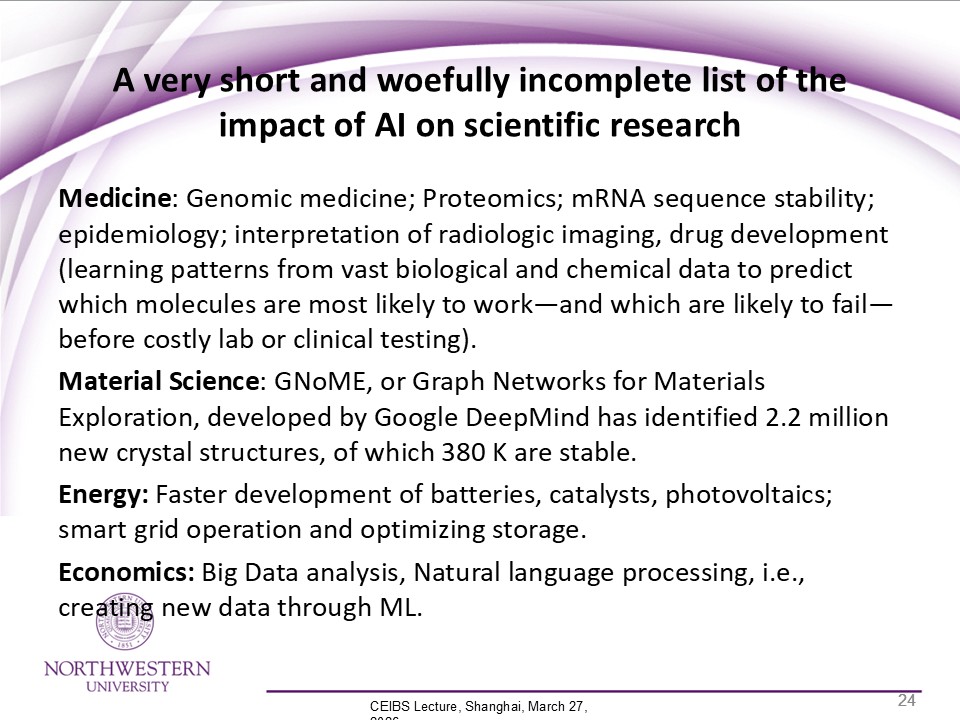
AI’s proponents frequently position it as “the mother of all general-purpose technologies”, with far-reaching applications in medicine, material science, energy, economics and hundreds of other fields. If properly harnessed, regulated and directed, AI could advance science while feeding back into new technologies in ways we cannot readily imagine, unleashing a wave of breakthroughs beyond that of any previous technological era.
How could it all go wrong?
For innovation to thrive, any given society must satisfy the following four conditions:
- Innovators and their investors are incentivised to think differently and pursue new ideas, rather than being threatened or constrained.
- There is a competitive, open, and free market for ideas – both the supply and demand sides are decentralised, and no single entity has too much market power.
- Scientists and original thinkers enjoy intellectual freedom of movement, locating wherever they can be most productive.
- The government takes a “Goldilocks” approach – not too controlling and not too absent.
These conditions were met to an ever-increasing extent in early modern Europe (1450-1750), securing the positive feedback loop and heralding transformative technological advancement. Despite an increasing sense of geopolitical uncertainty, they also broadly hold true across much of the world today. The marketplace of ideas, though clearly imperfect, has incentivised innovators to an unprecedented extent, massively rewarding the likes of James Dyson, Mark Zuckerberg and Sergei Brin, and less prominent inventors to a lesser (though still significant) extent.
But the very systems that support innovators and their inventions can be undermined with frightening speed. Each of the four conditions above is susceptible to the following opposing forces:
Economic nationalism: The rising global tide of sanctions, tariffs and NTBs, and closed support for “strategic industries”, undermines the flow of the marketplace of ideas and the spirit of international cooperation, slowing down progress considerably.
Populism: Crises relating to climate, immigration, and the cost of living have spawned new waves of populist politics across the world. One of the main features of populism is anti-elitism, which tends to devalue intellectuals, scientists, and academics, inhibiting their free thinking, free movement and systems of tangible support.
Xenophobia: Relatedly, immigrants have been shown to punch above their weight in cutting-edge innovative firms, but they are an easy target for populist politicians to vilify. The US’s decision to revoke its open-door policy (via H-1B visas) for top-quality foreign academics, inventors and entrepreneurs is a prime example of populist politics causing short- and long-term damage to a nation’s technological leadership and innovation capabilities.
Mis- and disinformation: A global market driven by electronic social media cannot ensure that good ideas will consistently drive out bad ones. Conspiracy theories and fringe beliefs can quickly fuel negative social and economic outcomes in the real world (e.g., anti-vax movements, “degrowth” advocates, and peddlers of technophobic hysteria).
Technological progress is a deceptively fragile ecosystem
While the principles of the positive feedback loop (science drives new technologies that enable further scientific breakthroughs) remain in place for now, there is no room for complacency or unbridled optimism.
Even if AI proves to be immune to the curse of diminishing returns and forges a series of tall ladders leading to hereto unimaginable heights of development, the conditions that support its ethical, equitable use are still vulnerable to fast-paced political and societal change. The techno-pessimists vs. optimists debate remains lively, with neither side holding a commanding position for now.
Regardless, the most serious headwind that endangers the human race’s collective progress is not national debt crises or ageing populations; it is the ramifications of ignorance. Recklessness, self-interest and mistrust, whether in the fields of politics, business or everyday social media interactions, can hamstring scientific exploration and advancement if left unchallenged.