


Faculty & Research

Faculty & Research
Kevin Kelly: The uncertain future of AI
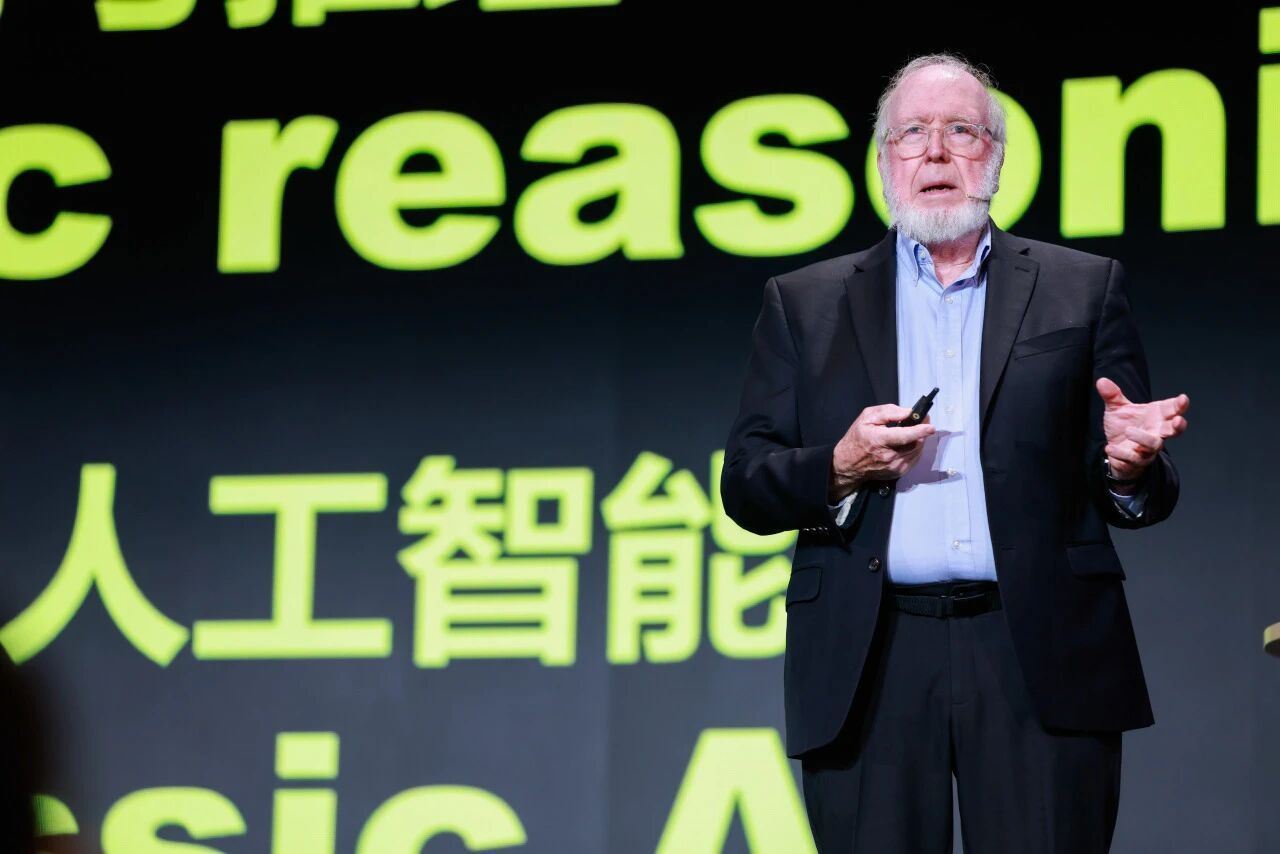
By Kevin Kelly
At the recent CEIBS EMBA 30th Anniversary Celebration, Kevin Kelly, the Founding Executive Editor of WIRED and author of "2049: Possibilities of the Next 10,000 Days", delivered a keynote speech, painting a picture of a future in which humans live alongside AI. The following is an edited partial transcript of this speech, covering the capabilities of AI, the future of this disruptive technology, and the potential consequences for businesses, society, and the world.
AI and its uncertainty
One thing we know for certain about AI is that its future is incredibly uncertain. And by uncertain, I mean that even the experts disagree. It’s not just misconceptions or a lack of information; the people who know the most about AI fundamentally diverge on where it’s headed.
I believe there are three major uncertainties. First, is artificial general intelligence even possible? Second, will computing evolve towards centralisation or decentralisation? And third, how will AI impact employment?
Uncertainty I: Is artificial general intelligence even possible?
The first question is whether we can ever create a system with broad, human-like intelligence — something that can think and learn as we do. The honest answer is: we don’t know.
We have the theories, and billions of pounds and dollars have been poured into research, yet the outcome remains unclear. It’s entirely possible we may never achieve true general intelligence. Instead, the future might consist of thousands of specialised “narrow AIs,” each excelling in its own domain.
Today, most funding flows towards general intelligence research, with major companies betting heavily on this path. But I believe it’s more realistic to focus on “AIs,” plural.
DeepSeek, OpenAI, and other leading models are built from collections of specialised systems working together. They’re not unified minds, but networks of modules.
And when we talk about intelligence, we shouldn’t limit ourselves to the human version. Different brains and learning architectures create different kinds of intelligence. Some animals outperform humans in certain tasks, while machines surpass us in others. Diversity in intelligence is natural.
Future AIs may include “alien intelligences,” systems that think unlike us yet reach meaningful conclusions. That difference is not a flaw — it’s a strength.
We need these alien perspectives to reveal ideas and solutions humans would never imagine. For this reason, I believe AI’s final form won’t be a single general-purpose mind, but an ecosystem of diverse intelligences.
Uncertainty II: Centralised or decentralised?
The second uncertainty concerns where AI computation actually happens. Will it occur mainly in massive cloud systems, or increasingly at the edge — on your phone, in a robot, or inside a car?
Most major companies are betting on centralisation. The logic comes from scaling laws: large language models have improved simply by growing bigger. More parameters, more chips, more power.
But this future is not guaranteed. Bigger models require enormous data centres, more energy, and heavier central control.
Meanwhile, a different trend is quietly advancing: edge computation. Today, around 70% of all computing cycles occur at the edge — on smartphones, thermostats, cars, factories, and local devices. AI may follow the same trajectory as hardware improves and models become more efficient.
Edge AI brings clear benefits: faster response times, stronger privacy, lower energy use, and greater autonomy.
In the future, intelligent devices — robots, smart glasses, autonomous vehicles — will be increasingly self-sufficient, processing information locally rather than relying on constant cloud access.
I believe we’re headed towards a hybrid architecture, where cloud and edge coexist, but the balance gradually tilts towards the edge. Such decentralisation may be what an intelligent society ultimately looks like.
Uncertainty III: Replacement or empowerment?
The third uncertainty concerns employment. Will AI replace human workers or empower them? Experts disagree here as well.
But what does the evidence show so far? Very few people have actually lost jobs to AI. Instead, we’re seeing measurable productivity gains — roughly 25% for people using AI daily.
AI is changing how we work, but not eliminating work. It removes repetitive tasks, allowing humans to focus on creativity, judgement, and relationships. AI replaces tasks, not jobs.
Take help desks: you may now talk to an AI first, but humans remain in the loop to handle complex cases. New roles — AI trainers, supervisors, evaluators — have emerged.
Every job is a bundle of tasks. AI can take over some, but the job itself remains because only humans take responsibility and exercise judgement. AI can’t apologise, reflect, or care.
Humans and AI complement each other. Collaboration, not competition, is the real story.
Frontiers and future directions of AI
Looking five to ten years ahead, I believe breakthroughs will centre on four frontiers: symbolic reasoning, spatial intelligence, emotional intelligence, and agents.
These developments reflect a move towards diverse, specialised intelligences working together.
1 Symbolic Reasoning: The return of structured intelligence
Most modern AIs rely on neural networks — powerful, but fundamentally statistical. They mimic language without truly grasping logic. They remain flat systems with limited reasoning.
To reach higher cognition, AI must incorporate symbolic reasoning — structured logic and causal understanding.
Future systems will blend bottom-up learning with top-down reasoning. The human brain itself is a composite of different modules; AI must also integrate reasoning, learning, planning, emotion, and memory.
Each component of intelligence brings trade-offs — speed vs complexity, accuracy vs energy. Managing these trade-offs will be a major challenge ahead.
2. Spatial Intelligence: Helping AI understand the real world
LLMs are smart about knowledge, but not about the world. They’re trained on words describing reality, not reality itself.
To operate in the physical world, AI must develop spatial intelligence: the ability to act, perceive, and understand how reality works.
Autonomous vehicles, robots, and future embodied systems need three-dimensional understanding, physics awareness, and real-world perception.
As AI learns from physical data — not just text — we may see large physical, chemical, and biological models. AI will become world-smart, not just word-smart.
This shift will transform how we interact with technology. Smart glasses will guide and inform us in real time. Digital twins will simulate cities, factories, and homes. AI will move from screens into our lived environment. Spatial intelligence marks AI’s entry into the real world.
3. Emotional Intelligence: Bringing empathy to machines
Emotion and intelligence are intertwined. For AI to coexist with humans, it must recognise and respond to emotion.
Machines can already detect tone, expression, and sentiment. Soon they’ll adjust their behaviour with empathy.
Imagine a smart toy comforting a child, or AI companions supporting mental health. Emotional bonds with machines will become real, much as our bonds with pets are real.
But this also raises profound questions about authenticity, boundaries, and responsibility.
4. Agents: From tools to partners
AI agents don’t just respond — they act. They can carry out tasks, collaborate, and operate autonomously. In the future, trillions of agents may run quietly in the background.
Agents may “hire” other agents, forming vast networks of digital subcontractors. This will lead to a new machine-to-machine economy, likely powered by stablecoins enabling automated micropayments.
But trust becomes a central challenge. How does one agent verify another? Solving this will be foundational to the AI economy.
As AI becomes ubiquitous and invisible — like electricity — the true competitive advantage will shift to the human-AI interface. Simplicity and intuitiveness will be the next great frontier.
AI, employment, industry, and organisational transformation
AI is reshaping work gradually but profoundly. To coexist with it, we must understand its pace and logic.
1. The pace of AI adoption
Even without new breakthroughs, it will take a decade to fully absorb today’s AI. Organisations must redesign workflows, decision structures, and cultures. AI becomes a new kind of “team member.” Start-ups adapt quickly; large organisations take longer. But adoption is now inevitable.
2. Two forms of AI adoption: Product vs Capability
Companies adopt AI as:
A product — developing or selling AI.
A capability — using AI internally to operate more effectively.
Often, the second evolves faster. AI becomes an invisible productivity layer, reshaping organisations much as electricity once did.
3. Knowledge-intensive industries lead the way
Fields rich in information — software, marketing, pharmaceuticals, education, finance — are early adopters. AI handles routine tasks; humans focus on complexity and relationships. New job categories emerge. AI amplifies human capabilities rather than displacing them.
4. The rule of three
Technological transformation follows a familiar pattern: the first attempt fails, the second is better, and the third succeeds.
AI adoption is no different. Early failures are inevitable — and necessary.
5. The new shape of work: Tasks will vanish, not jobs
AI will eliminate tasks, not professions. Responsibility, judgement, empathy, and creativity remain uniquely human. The future is “human + AI,” not “human vs AI.”
6. Responsibility and continuous learning
AI performs tasks but cannot take responsibility or learn continuously. Humans remain accountable. People won’t lose jobs because of AI — but they may lose competitiveness if they fail to learn how to work with it.
7. Creativity: Hill climbing vs hill making
AI excels at improving within existing frameworks (“hill climbing”). But humans create new fields and new questions (“hill making”). That remains our defining advantage.
Conclusion: Preparing for an uncertain future
The future of AI is uncertain in its direction, pace, and final form. But uncertainty should not cause fear. It should inspire exploration.
AI will evolve, reshape industries, and challenge our understanding of intelligence. Our greatest strength is our ability to learn, think deeply, and remain humble before the unknown.
AI is not a threat; it is a mirror, prompting us to define what makes us human. The most competitive people will be those who can collaborate, co-create, and grow with AI.
Just as electricity illuminated the industrial age, AI will light up the age of intelligence. And that transformation has already begun.